
EXIT Starts with E
for Essence

Until now, we have started the Exit Strategy journey with Theses. But there is something that comes before: the essence of your business.

When we study acquisition theses, it becomes clear that they are usually expansion moves: horizontal expansion into a new segment, vertical expansion along the supply chain, geographic expansion. Even technology acquisitions and acqui-hires are moves to expand the buyer’s capabilities.
Each of these moves can happen organically and gradually. Opening a new division, developing a new product or technology, hiring people. The inorganic path is faster, and time is money. But the expansion move, even when inorganic, must be coherent with the organization’s essence, and therefore with the choice of organizations to join forces with.
Essence Is Where Value Lives
When two organizations decide to come together, it is because there is something in the combination of their essences that makes sense to combine. I am talking about things they have in common, and things that are complementary, a topic I explored in depth in “You Don’t Marry Your Other Half.“
When I mentor founders using the Exit Strategy framework, it is important, before diving into theses, to understand more about the company and its founders. Only by understanding the identity of the company and its founders can we discuss which kind of expansion move they could be part of.
Before going deeper into essence, let’s start with more concrete examples that connect back to the theses:
To be a target in a vertical expansion move, either the company’s customers or its suppliers need to have the scale and strategic appetite of acquirers.
To be part of a horizontal expansion strategy, there need to be potential players in segments adjacent to where the company operates.
All of these concrete aspects of the organization derive from a deeper, more aspirational identity.
The Founder as the Source of Essence
When a company is founded, it is born from aspirations, beliefs, and motivations. This usually starts with a founder, who ends up joining forces with other partners and a founding team, either at the beginning or along the way.
This set of aspirations, beliefs, and motivations combines over time to form the organization’s deepest identity. I have seen years go by without this ever being formally translated into a mission statement, values, or a defined culture. But it is always there.
It reflects not only that aspirational dimension, but also a combination of competencies, polarities, and behaviors. It is fascinating to try to understand a company through this essential lens, because as it grows, the way it behaves, and even its strategy, products, services, and customer profile, will be a reflection of it.
As this crystallizes, it becomes very difficult to transform what has become the organization’s identity, even after its founders have moved on.
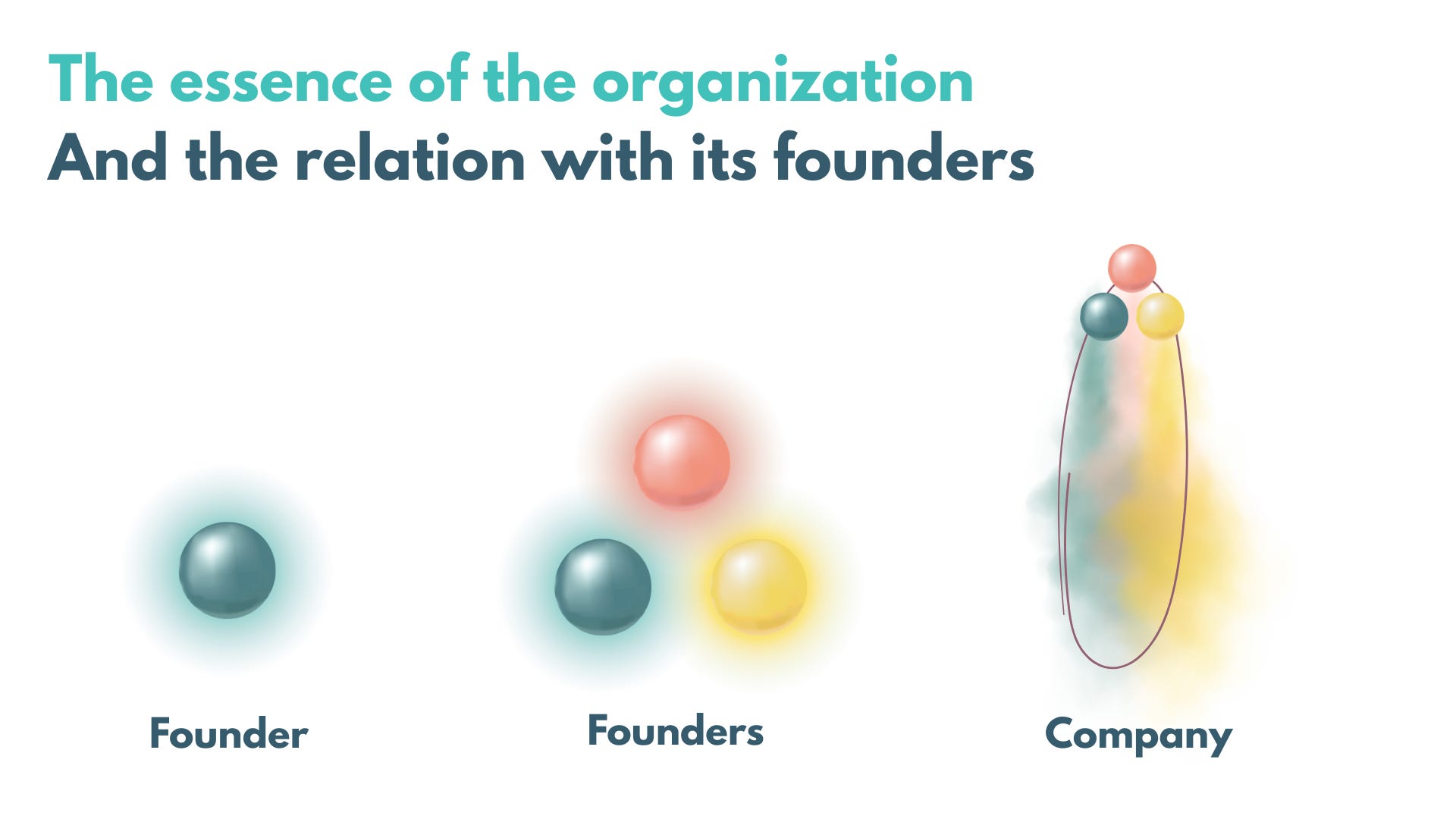
If there is one move capable of influencing an organization’s essence, it is a union with another company. That is precisely why it is crucial to start from an understanding of that essence before pursuing this kind of move.
A Framework for Understanding Essence
Understanding a company’s essence is a crucial step before going deeper into theses. And, as you might expect, I want to propose a new framework for doing that. There are many ways to map an organization’s attributes, most of them focused on a single level of abstraction. You can run due diligence and account for all tangible assets. You can conduct a strategic assessment to understand the company’s differentiators. You can evaluate cultural fit. But the truth is that each of these levels can matter in an acquisition or merger.
That is why I see value in a multi-level view, even if it starts at the surface. The goal here is to find what is essential, from the deepest and most aspirational to the most material and concrete. So let’s work through it in that order:
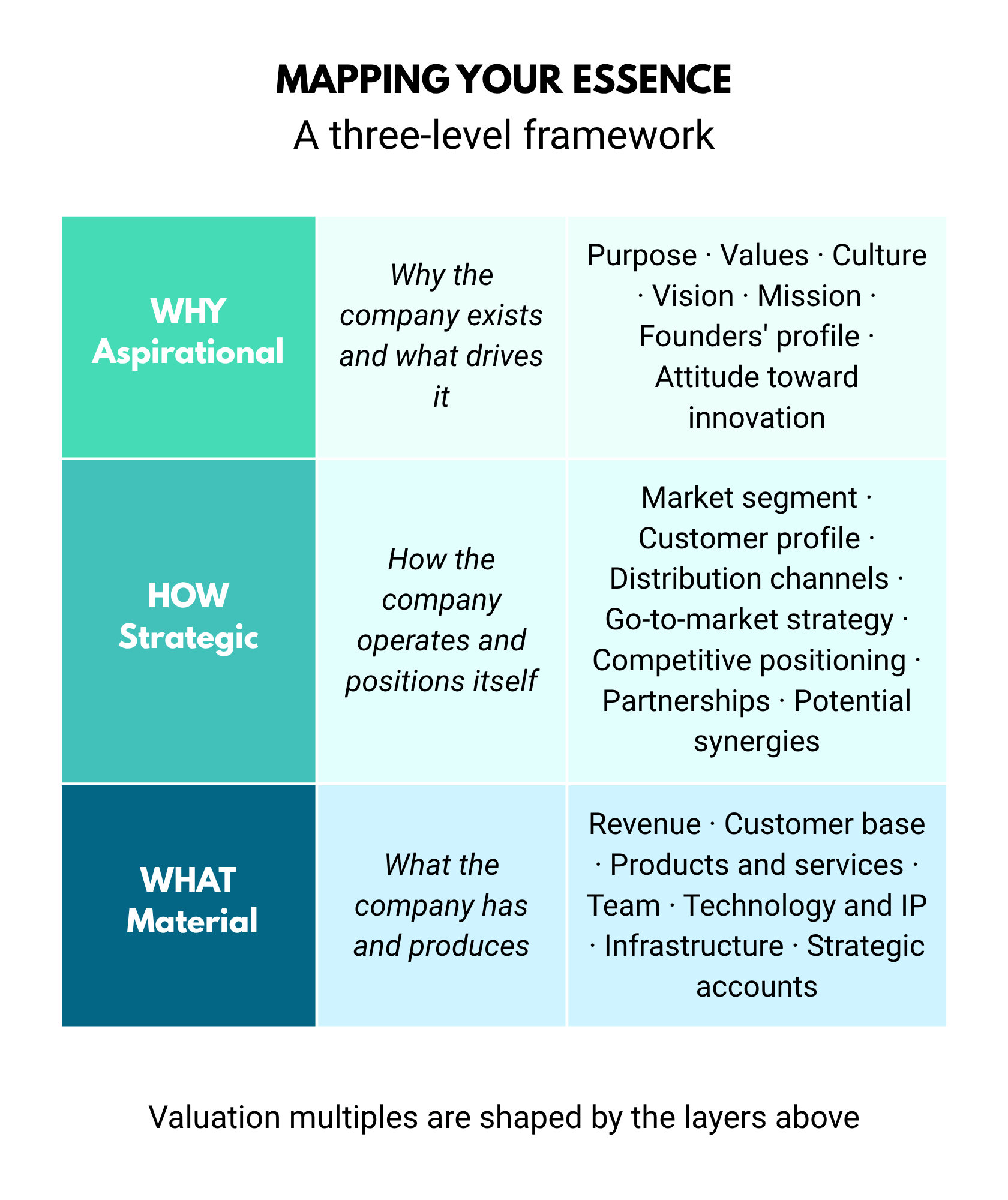
Aspirational — Why
Strategic — How
Material — What
Aspirational — Why
This is where everything else originates, the source of the organization’s greatest differentiators. Even though this framework calls all three levels “essence,” including the more material ones, it is here that they emerge, and it is with these aspirational attributes that everything else must remain coherent.
At the aspirational level, we map values, purpose, mission, vision, and cultural attributes. This also includes intangible qualities of the founders themselves, not just the company.
The aspirational level is not abstraction: it manifests directly in the organization’s strategies, positioning, behaviors, products, and customer profile. For example, if I were evaluating an acquisition of Anthropic or OpenAI, each would carry completely different aspirational attributes. Anthropic is tied to ethics and AI safety. OpenAI, to the scale of the vision and sheer ambition. These are distinct essences, and everything else about those companies is a reflection of that.
Each of these attributes can matter either as common ground, something the buyer would want to share with the acquired company, or as a differentiator. In other words, as a buyer I may be looking for something in the target’s essence that is compatible with mine, or I may be looking for something I do not find in my own essence because I need that complementarity.
Cultural fit matters for post-acquisition integration. On the other hand, a company looking to become more innovative may be seeking a startup that brings that aspirational quality precisely as something different from what it already has in-house.
Read the “other half” article to understand that distinction better.
Strategic — How
An organization’s strategy is what positions it most strongly in relation to expansion theses. Mapping the market segment, customer profile, go-to-market approach, and distribution channels is the first step toward understanding who the potential buyers are, whether in the value chain, in adjacent segments, or in the same segment across other geographies.
Understanding strategic attributes is also the foundation for identifying synergies and dis-synergies. If your company sells exclusively through a direct channel, there may be a significant synergy opportunity with a buyer that has a broad distribution network, something I considered frequently in acquisition evaluations during my time as M&A Director at TOTVS.
Material — What
At the most concrete level, we find the essence of the organization in facts and data. How many customers it has, which ones are strategic, how much it generates in revenue, what products or services it offers, how many employees, physical infrastructure, and so on. All of this also constitutes your company’s essence, though at a fairly material level.
This is where value is conferred through the size of the business. It is no coincidence that companies are frequently valued using multiples, of revenue, of EBITDA. We are using size as a proxy when we do that. But what influences the multiple itself lives in the levels above.
Starting the Exit with E, for Essence
Understanding essence before theses changes the starting point of the journey. And that realization changed the way I think about the framework as a whole.
The MVP Journey we have built together here is still alive. But it gets a new name and a new starting point. I now call it the EXIT journey, and it begins exactly here: with E, for Essence.
In the coming articles we will work through each of the letters that follow. For now, the invitation is to look at your business through this lens before any thesis: what is essential about your company? What, combined with the essence of another organization, could create something greater than the sum of its parts?
That is the question that starts everything.