
The Implantable Idea Pitch
Part I


The concept of the Implantable Idea Pitch (IIP) has a very clear inspiration. It's the film "Inception (2010). In it, Leonardo di Caprio's character gives the following speech:
"What is the most resilient parasite? Bacteria? A virus? An intestinal worm? An idea. Resilient... highly contagious. Once an idea has taken hold of the brain it's almost impossible to eradicate. An idea that is fully formed - fully understood - that sticks; right in there somewhere."
The plan, within the almost psychedelic universe of the film, is to invade another character's dream while they sleep to implement an idea. In real life we can't enter other people's dreams. But the concept of planting an idea in someone else's head, oh, this is very powerful and extremely doable. More than that, I would say that this is what differentiates winning companies. The ability to share ideas, infect your team with dreams, purpose, mission. Inspiring leadership has the ability to communicate ideas and make other people absorb them as if they were their own. And this is a crucial part of being able to implement ideas. They must actually be built in the receiver's head, by him or her.
The co-construction of the implemented idea
In "The IKEA Effect", we delve deeper into the feeling of ownership and attachment of someone who built something. Therefore, an idea will only be properly fixed in another person's head if it is built by them themselves. Otherwise, the lack of a sense of ownership will make this idea be seen with disdain and so be it, in practice discarded as a personal motivation tool for anything.
How then can we talk about implementing an idea, if it is someone else who needs to build it? Some of the answers are in "The New Art of Negotiation". There we explore the use of tools to involve your interlocutor more deeply in the construction of a solution, specifically for a problem that lacks a solution. The new art of negotiation is in practice a movement of co-construction. This is therefore how it should be the implantation of an idea.
It may seem unfair to call this 'implantation' since it is impossible for the person to build with you exactly the same idea that you have in your head. And that's okay. It doesn't have to be exactly the same idea.
We are studying the discipline of implementing ideas in the context of M&A, so the "master" idea we are implementing is that "our companies should join forces" or "together we are stronger than one against the other". There are already two variations of ideas that go in the same direction and will help you build a path to your goal. The very idea you have in your head of how and why companies should join forces will change in the co-construction processes, it may change in the process and this is extremely positive.
The Seed
If the idea is going to grow and take shape in the other party's head as something original and their property, it needs to start with something very small and specific. The truth is that these master idea examples like "our companies should join forces" are too crude to be implemented. This means that they are likely to be met with resistance for a variety of reasons, such as:
"No, because we are direct competitors"
"No, because we want to destroy you"
No, because we don’t need you.”
And so on. The only chance for the raw idea to be well received by the other party is for it to find resonance in a sister, similar idea such as:
"Yes, we want to buy you"
"Yes, we really need to merge with someone like you"
"Yes, we are dying to incorporate your technology into our product"
You don't want to take that risk if you don't know that there is already this intention on the other side. If the other party has already taken the lead in putting an idea like these on the table, you may not even need to bother implementing anything. But probably even in this case, you will need it because an organization does not make the decision to buy another, nor to merge. People are the ones who take it, and several of them will be involved in this process. Therefore, you may need multiple deployments. Take a deep breath and let's go together.
Reasons for Objection
In the sales discipline, the concept of "reasons for objection" is famous. It is used to refer to those reasons that prospects repeatedly give for not buying your product. In mergers and acquisitions and more specifically in the discipline of implementing ideas, reasons for objection are the way to find the seed of the Implantable Idea Pitch.
"We are direct competitors", for example, is a reason for objection that can lead to a seed of complementarity. The implantable idea in this case will not simply be "we must join forces", but rather something like "we are complementary in this and this point".
The problem is that if you hear the reason for objection trying to implement a master idea, it may have harmed or even prevented the implantation of the seed. So it's ideal to identify the seed before trying to implement any idea.
To do this, you may need to think with your interlocutor's head. This isn't simple at all, so let's go in parts.
The reasons for objection may be superficial like "we are direct competitors", but they may be hidden much deeper than that. Superficial motivations are usually impersonal and based on something in the public domain, but which reflect the company's macro strategy. Direct competition is a strategic vision of the relationship between the two companies, but it is still superficial. We can list at least 4 more levels of reasons for objection.
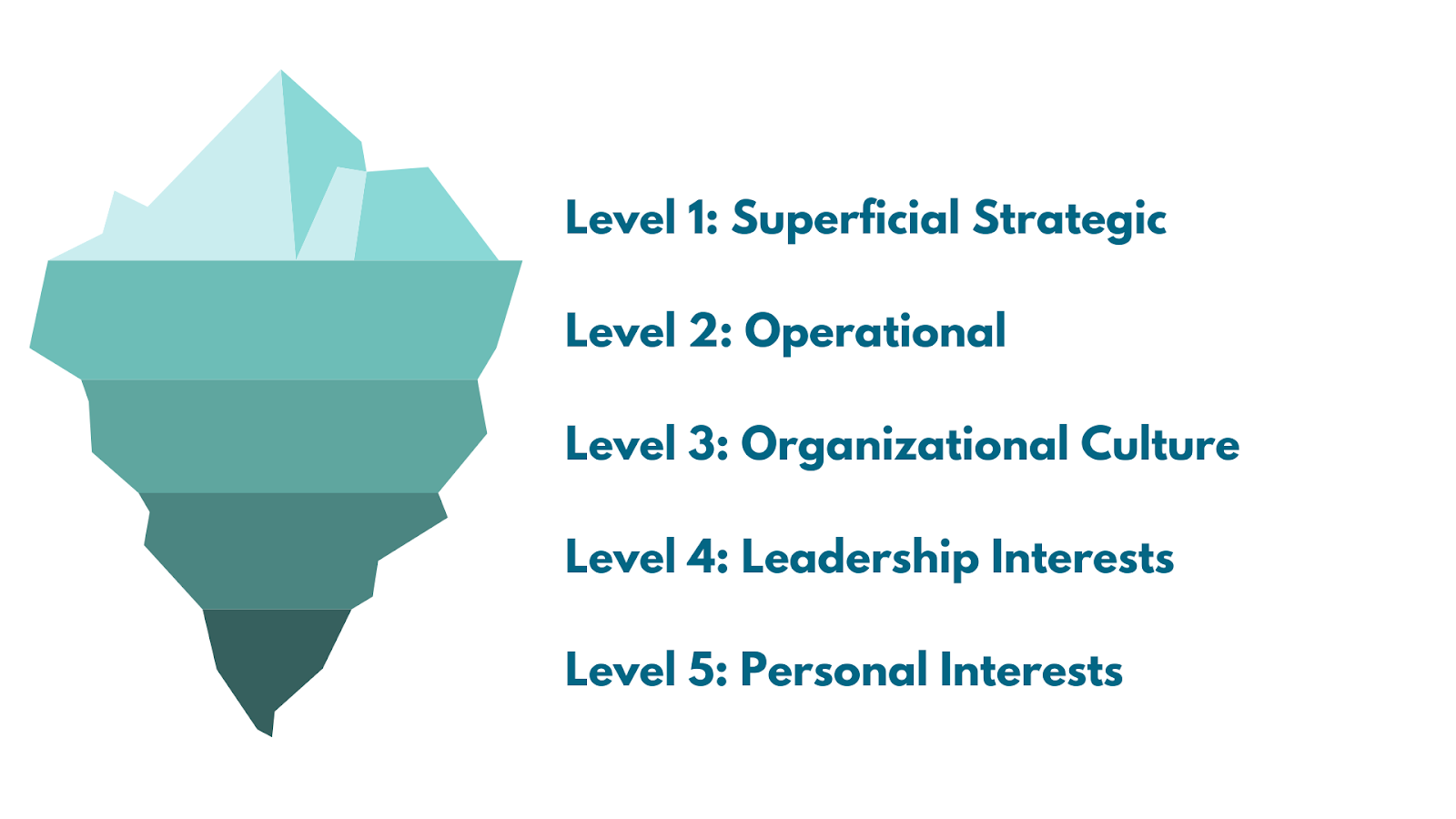
Level 1 (Surface): Shallow Strategic
Reasons based on public information and company macro strategies
Example: "We are direct competitors"
Level 2: Operational
Concerns related to the integration of processes and systems
Example: "Our technologies are incompatible"
Level 3: Organizational Culture
Resistance based on cultural differences between organizations
Example: "Our corporate values are very different"
Level 4: Leadership Interests
Motivations linked to the goals and visions of company leaders
Example: "Our board has a different vision for the company's future"
Level 5 (Deep): Personal Interests
Individual motivations of decision makers
Example: "I fear losing my position after the merger"
As an outsider to the organization, you likely know very little about the deeper levels. This is one of the reasons for you to walk along the "Spectrum of Relationships", forming close relationships and partnerships before implementing an M&A idea.
When it comes to personal interests, this can be especially challenging, you may need to talk to people close to you who know your interlocutor, or develop a personal relationship close enough to allow you to practice thinking with your interlocutor's head.
Transforming Reason for Objection into Pitch
The process of identifying reasons for objection is the first step in building an IIP. The seed for building the implantable idea will be extracted from it, and we will formulate the pitch from it.
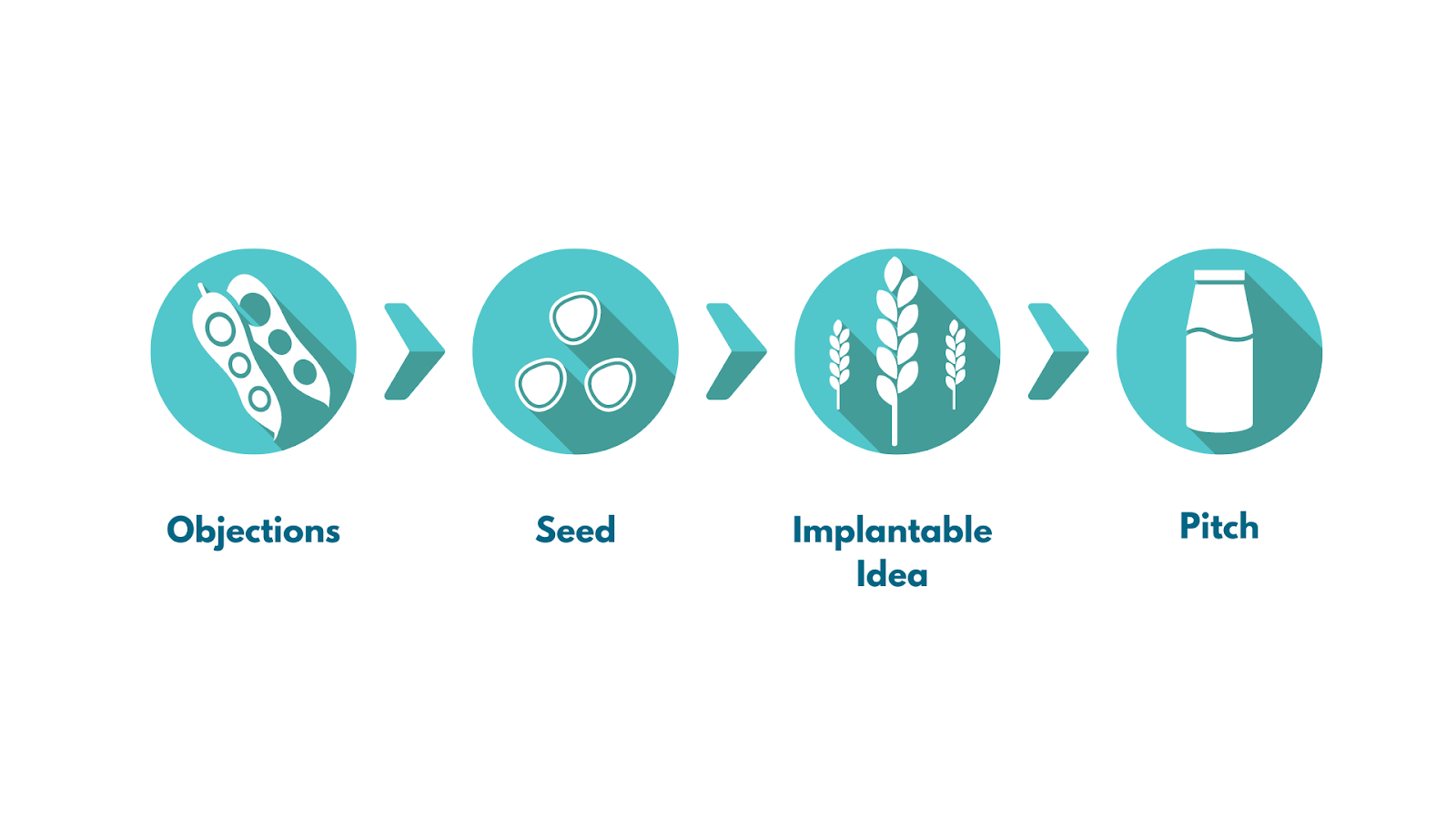
Some examples of this transformation:
Level 1 - Superficial Strategic
Objection: "We are direct competitors"
Seed: Complementarity of forces
II: Synergy potential through complementary strenghts
IIP: "In which segments do you see you as superior and in which do you see us as having an advantage?"
Level 2 - Operational
Objection: "Our technologies are incompatible"
Seed: Integration opportunities
II: Possibilities for quick gains through specific integrations
IIP: "Where can we have a quick win in technological integration with low effort and high return?"
Level 3 - Organizational Culture
Objection: "Our corporate values are too different"
Seed: Cultural diversity as a strength
II: Mutual enrichment through diversity of perspectives
IIP: "What practices or values from our company do you believe could add value to your culture?"
Level 4 - Leadership Interests
Objection: "Our board has a different vision for the company's future"
Seed: Alignment of complementary visions
II: Potential for innovation through the combination of different strategic perspectives
IIP: "How do you imagine our different visions of the future could complement each other to create something unique on the market?"
Level 5 - Personal Interests
Objection: "I fear losing my position after the merger"
Seed: Opportunities for personal growth
II: Possibilities for expanding influence and professional impact
IIP: "What types of professional challenges would you like to face if you had access to more resources and a larger platform?"
Pitch Formulation
The examples above represent the first part of an Implantable Idea Pitch. As we are talking about a co-construction process, it will be delivered through a dialogue. But this dialogue should ideally start with an open question, as we delve into in "New Art of Negotiation".
Although the examples address the 5 levels of objection reasons, there are a few more dimensions that we can use to develop a good IIP. That's why this article was divided into parts.
In the next sections we will delve deeper into how to prepare the most appropriate pitch for each M&A thesis and also according to the profile of your interlocutor.
Wait for it!